RPAA Registration in 2026: Is Your Payment Provider Allowed to Process Your Payments?
WRITTEN BY

Dylan Coombs
Citcon
Commercial Leader
Date
Oct 19, 2026
Subscribe to our interesting updates
SHARE ON

Your checkout may depend on a regulatory decision you have never heard about.
Since September 8, 2025, the Retail Payment Activities Act (RPAA) has been fully in force. Registration with the Bank of Canada is mandatory for payment service providers serving Canadian merchants. A provider that is refused registration must stop serving its merchants.
Most businesses have never checked their provider's status. This guide explains what the law requires, why your provider's status is your risk, and how to verify it in about five minutes.
Key takeaways
- Payment service providers serving Canada, including foreign providers, must register with the Bank of Canada under the RPAA.
- Money services business (MSB) registration with FINTRAC does not replace PSP registration with the Bank of Canada.
- Hundreds of providers are still waiting on a decision, and a refused provider must stop serving merchants.
- Alternative payment providers, including digital wallets and buy now, pay later services, must also register under the RPAA.
- The Bank of Canada publishes its PSP lists online, so anyone can check a provider's status.
What the Retail Payment Activities Act requires
The Retail Payment Activities Act is Canada's federal framework for supervising payment service providers (PSPs). The Bank of Canada is the supervisor, and the law came into full force on September 8, 2025. Registration applications opened in November 2024.
The core rule fits in one sentence: a payment service provider must register before handling retail payments in Canada.
That covers companies that process, transfer, or hold funds for merchants and consumers. Foreign providers that serve users in Canada are covered too. Banks and credit unions are excluded because they are supervised under other regimes. Registered and pending providers must also meet ongoing requirements, including rules on operational risk and how they safeguard the funds they hold for users.
MSB status is no longer enough
For years, many payment companies operated as money services businesses. That status was enough to sign merchants and process their payments.
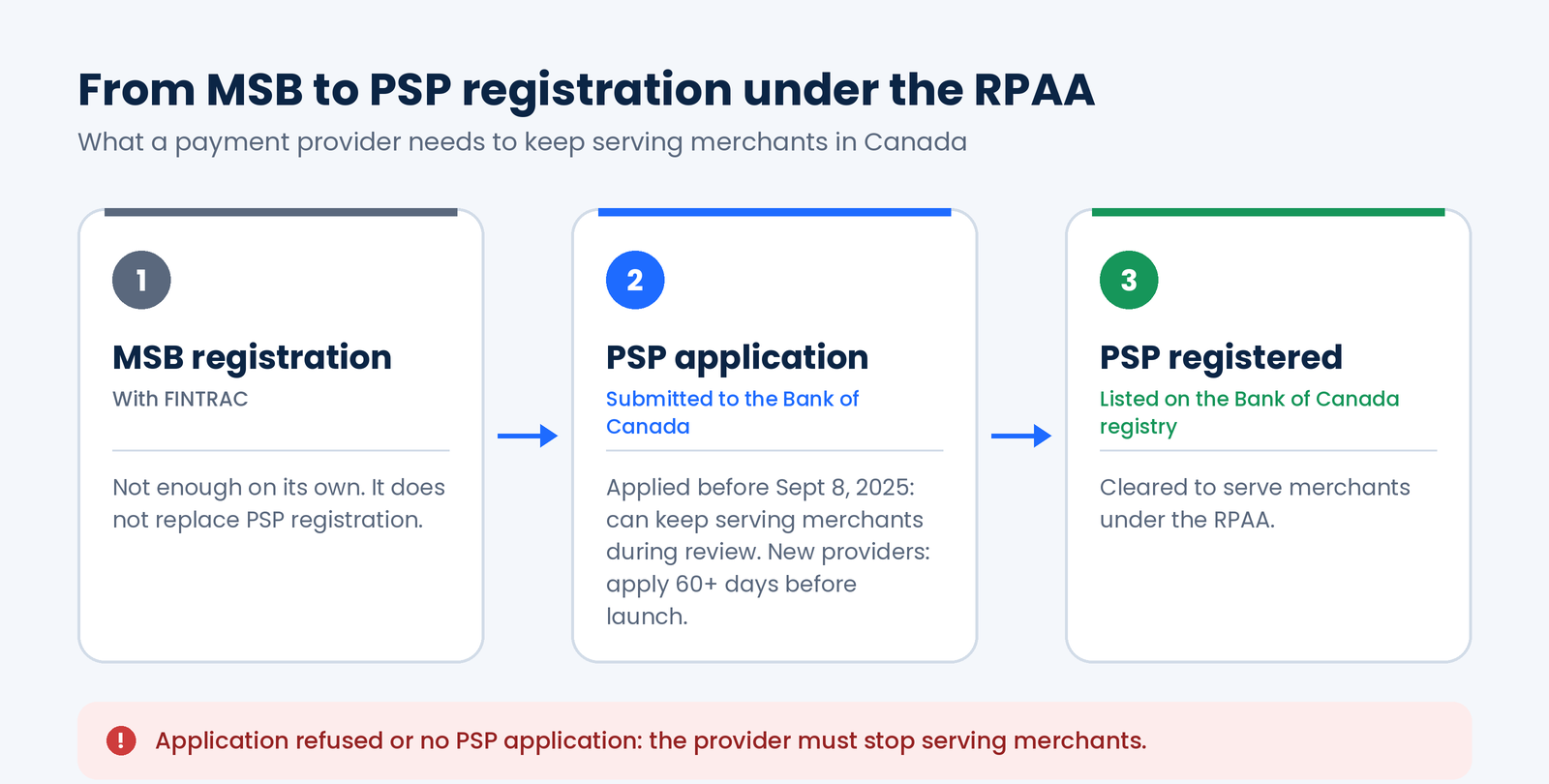
Under the RPAA, it is not. Providers that were already operating, including MSBs, had to apply before September 8, 2025. They can keep serving merchants while the Bank of Canada reviews their application. New providers must apply at least 60 days before launch and cannot serve merchants until they are registered.
The pending row deserves the most attention. Pending keeps a provider operating today. It does not guarantee approval tomorrow.
Why your provider's status is your risk
The registration obligation belongs to your provider. The consequences of a refusal land on you.
If your provider has to stop serving merchants, the impact shows up fast:
- Checkout gaps. You cannot accept payments through that provider until a replacement is live.
- Lost sales. Customers who cannot pay their preferred way often leave without paying at all.
- Unplanned technical work. Your POS, website, or app has to be connected to a new processor.
- Settlement friction. Closing one contract and opening another takes time you did not budget for.
The fair counterpoint: pending is common
A pending PSP application is not a red flag on its own. The Bank of Canada is still working through a large backlog of RPAA registrations. As of October 2026, 422 payment service providers were still awaiting a decision, according to the Bank’s official list of applicants.
What matters is how your provider handles the question. A provider with a clear answer and a realistic timeline is managing its risk. A provider that avoids the question is asking you to carry it.
The alternative payment methods blind spot
If you accept alternative payment methods like digital wallets, buy now, pay later, or cross-border wallets, check those providers as well. They often serve some of your highest-value customers.
Not every payment provider in Canada has completed its PSP registration. The simple question to ask is: has mine? Search your provider’s legal name in the Bank of Canada’s official PSP registry. If it’s not listed, ask where its application stands and when it expects a decision.
If alternative payment methods drive a meaningful share of your revenue, put those providers at the top of your verification list.
How to check your payment provider in 5 minutes
You do not need a compliance team for this. Follow these steps:
- Find your provider's legal name. Check your merchant agreement, monthly statements, or invoices. The registered entity often differs from the brand name.
- Search the Bank of Canada lists. Go to the Bank of Canada PSP registry and search that legal name. Note which list it appears on: registered, under review, or refused or revoked. If it appears on none of them, ask why.
- Look for a public announcement. Providers that receive PSP approval typically announce it. If you cannot find one, ask why.
- Get it in writing. Ask your account manager to confirm whether the company is approved, pending, or not registered.
- Check every provider in your stack. Card processor, payment gateway, and alternative payment providers. If it touches your money, verify it.
- Plan a fallback. If any provider is pending or unregistered, identify a registered alternative while you still have time to compare options.
Copy-and-paste email for your provider
Hi [Name],
As part of our RPAA review, can you confirm the following?
- Is your company registered as a PSP with the Bank of Canada?
- If your application is pending, when did you apply, and when do you expect a decision?
- What happens to our account and settlements if the application is refused?
- Will you notify us in writing if your status changes?
- Can you point us to your entry on the Bank of Canada PSP registry?
Thanks,
[Your name]
A provider that is confident in its status will answer all five clearly and quickly. Vague or slow answers tell you something too.
What verified registration looks like
Registration should be something you can confirm yourself, not something you take on trust from a sales call.
As one example, Citcon Canada holds PSP registration with the Bank of Canada. You can confirm it the same way you would check any provider, by searching the Bank of Canada PSP registry.
Hold every payment partner to that standard.
RPAA FAQ for merchants
Do merchants need to register under the RPAA?
Generally, no. A merchant that only accepts payments for its own goods and services is not the party the RPAA registration requirement targets. Merchants are affected because their provider's status decides whether it can keep serving them. If your business also moves funds on behalf of others, such as a marketplace or platform, get legal advice on whether the RPAA applies to you.
What does a pending application mean for my business?
Your provider can keep serving you while the Bank of Canada reviews its application (if it applied before September 8, 2025), and it still has to follow the RPAA in the meantime. If the application is refused, the provider must stop serving merchants.
Where can I check a payment provider's status?
The Bank of Canada PSP registry is the official source, and the Bank updates its lists regularly. You can also request written confirmation from your provider.
Do alternative payment providers need RPAA registration?
Generally, yes. If a provider processes, transfers, or holds funds for your business, the RPAA likely applies, whether it handles cards, digital wallets, or buy now, pay later payments. Search its legal name in the Bank of Canada PSP registry to confirm its status.
What should I do if my provider is not registered?
Ask for its application status and expected timeline in writing, then start evaluating registered alternatives so a refusal does not leave you without a way to get paid.
The bottom line
The RPAA turned a regulatory detail into a revenue question. Merchants with registered providers have continuity. Merchants with pending or unregistered providers are relying on an outcome they cannot control.
Five minutes on the registry tells you which group you are in.
Check your provider on the Bank of Canada PSP registry today. Looking for a registered payment service provider in Canada? Talk to the Citcon team.
Have you checked your provider's RPAA status yet? Share this guide with a merchant who should.